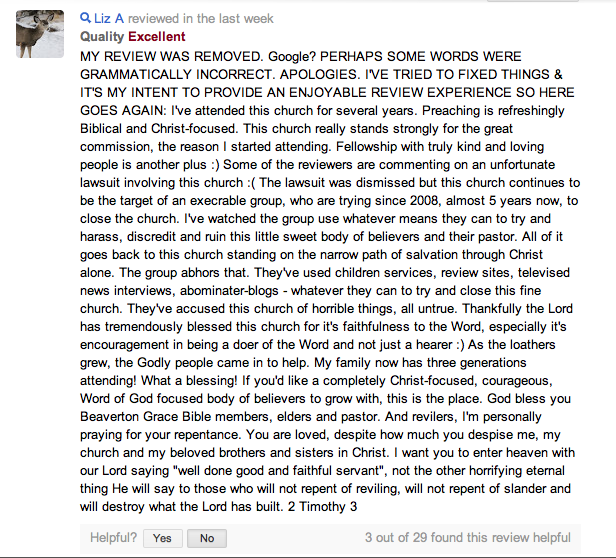
In my former church our pastor spoke that our church was different than others because he preached a tough gospel message. It was implied that people in other churches would have difficulty getting through the narrow gate to heaven because their pastors preached what they wanted to hear, not what was necessary to get to heaven. Our pastor didn't water down the Word and wasn't into seeker-sensitive or easy-believisim teachings. Some current church members even mentioned this narrow gate wording on their Google reviews which have since been revised or/or removed. It was (is) a source of pride among the congregation. We felt thankful that we didn't have to listen to other pastor's sermons which were most likely weak. There was a sense among us that other pastors must not love their congregations the way ours did because our pastor preached the hard teachings. We were special ones to have this teaching, even though it meant a more difficult path.
Spiritual abuse pattern: A common trait in spiritually abusive churches is elitism. If we are so special, and all others churches are inferior, who wants to attend an inferior church? Elitism is a manipulation tactic to keep people at the church. And it works powerfully because we become convinced that no other church will measure up to our elite church.
“Enter by the narrow gate; for wide is the gate and broad is the way that leads to destruction, and there are many who go in by it. Because narrow is the gate and difficult is the way which leads to life, and there are few who find it. Matthew 7:13-14
What we saw modeled to us to get to that narrow path, however, was works-based religion. We felt the need to be present at all church meetings. If there was a car wash evangelism outreach, it was important to be there. We felt pressure to go out and and evangelize on Friday nights, to other events he deemed important. We had to use the right formula for evangelism, we had rules of how to dress, there were rules of when women could talk, what members did with our time outside of church. Somehow, the pastor did not need to say a thing and people still felt pressure and could hear his rules in their heads. These were unspoken rules. I've spoken to a number of people who sensed this pressure and felt guilty for not attending a specific event or teaching.
Religion always teaches that you can get to God by doing something. Your good standing with God depends on what you do. Do the law, perform religion, do it right, look good, try hard. Is that the gate through which we are called to find life? No. Those leading people to it are ravenous wolves in sheep's clothing. They look like sheep, and they appear to be the safest, most righteous, but they lead people down the wrong path. Jesus plus anything is not Jesus!
(from The Subtle Power of Spiritual Abuse by David Johnson & Jeff VanVonderen)
Look at the verse following the narrow gate passage:
15 “Beware of false prophets, who come to you in sheep’s clothing, but inwardly they are ravenous wolves.
I discussed a bit of this with my friend, Pastor Ken Garrett. Ken has first-hand experience of being involved in an abusive church for over a decade and has studied spiritual abuse at great length. I always appreciate his insight. He shared this with me and it goes right along with what we and so many people experience in abusive churches:
Dogmatic, demanding preachers are prone to boast that their "gospel" is THE narrow way; and they can usually point to a truck-load of rules, mores, taboos, and religious expectations and dogmatic doctrines that they've laid on their followers as evidence of just how "narrow" their way is! Basically, any church that doesn't seem as "strict" as their church immediately is accorded the "broad-and-wide-way-that-leads-to-death" title. It's the theology of bullies, and is an affront to God's marvelous grace.
Ken is exactly right. A typical pattern we see in these churches, as Ken alludes to in the last sentence, is a lack of grace. There is no gospel without grace. If a pastor says "grace" from the pulpit, but his life and actions reflect otherwise, is he preaching the gospel? I don't think so. Preaching is much more than the words coming from the pulpit. A pastor preaches and models to his congregants through his words and actions after the service, during the week as he rubs shoulders with congregants and those outside the church.
Anyone can get caught up into a church like ours. Because so much seemed biblical and accurate from the pulpit, I had difficulty articulating what the real problem was. I share our personal accounts because my husband and I had been Christians over 30 years and we were fooled. I knew something was wrong the first time I walked in the place, but could not identify it. It took leaving the church, getting out of the environment completely to see things clearly, and even then, it was a process. The wool was pulled over our eyes. We drank the Kool-Aid. The after-effects of the Kool-Aid are wretched and painful. We are still dealing with it.
I hope our story helps to illustrate how false teachers creep in and can get even seasoned Christians fooled. Just because your pastor teaches the hard gospel and uses scripture to back it up, and preaches against false teachers, calling them out, does not mean that your pastor is not a wolf. Scripture says that they creep in unnoticed. Their objective is to devour. Look for the inconsistencies in their words. If they preach grace, is the fruit evident in their lives and words away from the pulpit and in their personal life in dealings with others?
photo credit: Norma Desmond via photopin cc